


Americans are expected to spend more than $100 billion through social commerce this year, buying products without leaving the app where they discovered them. The milestone matters less because of the number itself than because it reflects how shopping has changed. Entertainment and commerce are no longer separate experiences. For much of the internet's history, buying something meant leaving one place for another. You watched a video, read an article or scrolled a feed, then followed a link to a retailer. Increasingly, that extra step is disappearing. Products can be bought inside a livestream, a short video or a creator's page, often without interrupting the experience at all. Livestream commerce can convert at rates approaching 30%, compared with roughly 2% to 3% for a typical ecommerce website, because the decision to buy happens in the same place where attention was captured. Many of the companies in this week's issue are working towards the same outcome, making the moment of attention and the moment of transaction as close together as possible.



That has become increasingly obvious across the attention economy. Most digital platforms have reached a point where attracting new attention is expensive. Feeds are crowded, advertising costs have risen and consumers have only so many hours in the day. Instead of trying to create new destinations, many businesses are finding ways to make existing attention more valuable. Social commerce is one example. Buying no longer requires leaving the app where the product was discovered. Livestream shopping has brought entertainment and checkout into the same experience, helping explain why conversion rates are often far higher than on a traditional ecommerce website. The same logic appears elsewhere. Sneaker releases and trading card breaks generate secondary markets around scarcity. Car dashboards, digital billboards and seatback screens have become advertising inventory because they already command attention. Even focus and meditation apps are built around people trying to recover time from the very devices competing for it. Not every attempt has worked. Virtual real estate attracted enormous investment before discovering there were too few people spending meaningful time there. Drop in audio followed a similar path as audiences drifted back to offline life. In both cases, the technology arrived before the habit. The businesses growing today are generally not asking people to find somewhere new to spend their time. They are finding commercial opportunities inside behaviours that already exist. This week's issue looks at where that approach is working, and where it has proved much harder than expected.

The rails. Whatnot does not simply host live video. It owns the transaction. Every auction takes place inside the platform, with sellers paying fees that amount to a take rate of roughly 12.5%. The livestream, the countdown clock, the host and the bidding all happen in the same place, so the moment of entertainment and the moment of purchase are difficult to separate.
Investors have continued to back that model. Whatnot was valued at about $1.5 billion in 2021, around $5 billion at the start of 2025 and $11.5 billion after a $225 million funding round in October 2025 led by DST Global and CapitalG. Gross merchandise volume reached more than $6 billion in 2025, roughly double the previous year. Users now spend around 80 minutes a day on the platform, monthly retention is reported to be close to 80%, and industry expectations continue to point towards a public listing in late 2026 or 2027.
Whether that valuation proves justified depends on what Whatnot becomes over the next few years. If it remains primarily a marketplace for trading cards, sneakers and collectibles, it will eventually run into the limits of those categories. If live commerce develops in the United States the way it has in China, where livestream shopping has become part of everyday retail, the addressable market looks very different. That shift is still far from guaranteed. Live shopping has been predicted to break into the mainstream in Western markets for years, and the company continues to face operational challenges, including customer arbitration claims reported by The New York Times earlier this year. Even so, investors appear to be valuing something larger than a collectibles marketplace. They are backing the idea that buying and watching become part of the same experience, and that the company controlling that experience becomes difficult for both buyers and sellers to replace.

Spend enough time looking across the attention economy and one habit starts appearing in very different businesses. The winners are rarely asking people to spend more time somewhere new. They're finding ways to earn more from attention that already exists. Social commerce, collectibles, digital advertising and even focus apps all point in that direction. The mechanics are different. The commercial instinct is remarkably similar.
Act one: watching is buying
Social commerce is probably the clearest example. Americans are expected to spend more than $100 billion buying products without leaving the apps where they discovered them, and video sits at the centre of that shift. TikTok Shop alone is projected to generate about $23 billion in US sales during 2026, overtaking the ecommerce businesses of retailers such as Target, Costco and Best Buy only a couple of years after launching. Part of the appeal is practical. Buying no longer interrupts the experience. A viewer watching a livestream can purchase the product without opening another website or searching for it later. That helps explain why livestream commerce can convert at rates approaching 30%, compared with roughly 2% to 3% for a typical ecommerce site. Collectibles arrive at the same destination from the opposite direction. Rather than placing a shop inside entertainment, they turn the product into the entertainment. Limited sneaker releases, numbered trading cards and live box breaks create an audience before the sale even happens. StockX and GOAT earn a fee each time those products are resold, while Fanatics has gone further by acquiring exclusive trading card licences for the NFL, NBA, MLB and WWE. Fans can move between merchandise, collectibles and sports betting without leaving the same ecosystem.
Act two: the screens you never asked for
The next stage has less to do with apps than with the growing number of screens surrounding everyday life. Stellantis has begun placing full-screen advertising on the dashboards of Jeep, Ram and Chrysler vehicles as part of its connected services business. Amazon's Echo Show adjusts advertising based on how far a user is standing from the display, and the company has explored ways for Alexa to recommend products during conversations. Digital billboards are increasingly bought and sold through automated advertising exchanges, while United Airlines has turned more than 100,000 seatback screens into an advertising network capable of serving targeted campaigns during flights. None of these businesses had to persuade people to download another app. The audience was already there. The commercial opportunity came from finding another use for the attention those surfaces already attracted.
Act three: the empty rooms
That helps explain why some of the most ambitious ideas of the last few years have struggled. Virtual real estate promised a future where digital land would become as valuable as physical land. Instead, prices on platforms such as Sandbox and Decentraland have fallen dramatically from their peaks. A virtual property purchased beside Snoop Dogg's estate for roughly $450,000 now changes hands for around $1,000. Meta is winding down Horizon Worlds after years of investment and limited consumer adoption. Drop in audio followed a similar path. Clubhouse reached a valuation of about $1 billion before audiences drifted back to existing platforms once lockdowns ended. Discord, X and podcasts absorbed much of the behaviour that initially made Clubhouse feel new. Neither idea lacked technology. Both struggled to become places where people consistently chose to spend their time. One of the more interesting consequences is that attention has become valuable enough to create a market for escaping it. Focus apps such as Forest encourage users to stay away from their phones by rewarding uninterrupted concentration, while commitment apps charge users money if they fail to keep promises they've made to themselves. Businesses that compete for attention now sit alongside businesses built to protect it. Looking across all of these examples, the same distinction keeps appearing. Some companies begin with an audience and work out how to build a business around it. Others build the business first and hope the audience follows. That difference doesn't guarantee success, but it shows up often enough to be worth paying attention to. Before building somewhere new for customers to spend their time, it may be worth asking where they're already spending it.
Yesterday's trading session (June 18, 2026) provided a masterclass in how market volatility impacts highly specialized attention real estate. As the broader markets navigated late-week structural adjustments, we saw a distinct premium placed on unskippable, hardware-integrated attention nodes (ambient smart home ecosystems and in-car infotainment) over more volatile, fluid consumer retail concepts. Capital continues to cluster around environments where user attention is locked in by default, while heavily penalizing networks built on manufactured consumer hype or secondary, high-churn audio-visual platforms.
Below are the tables tracking the 5 best and 5 worst performing stocks weaponizing these precise frontiers as of yesterday's closing bell.
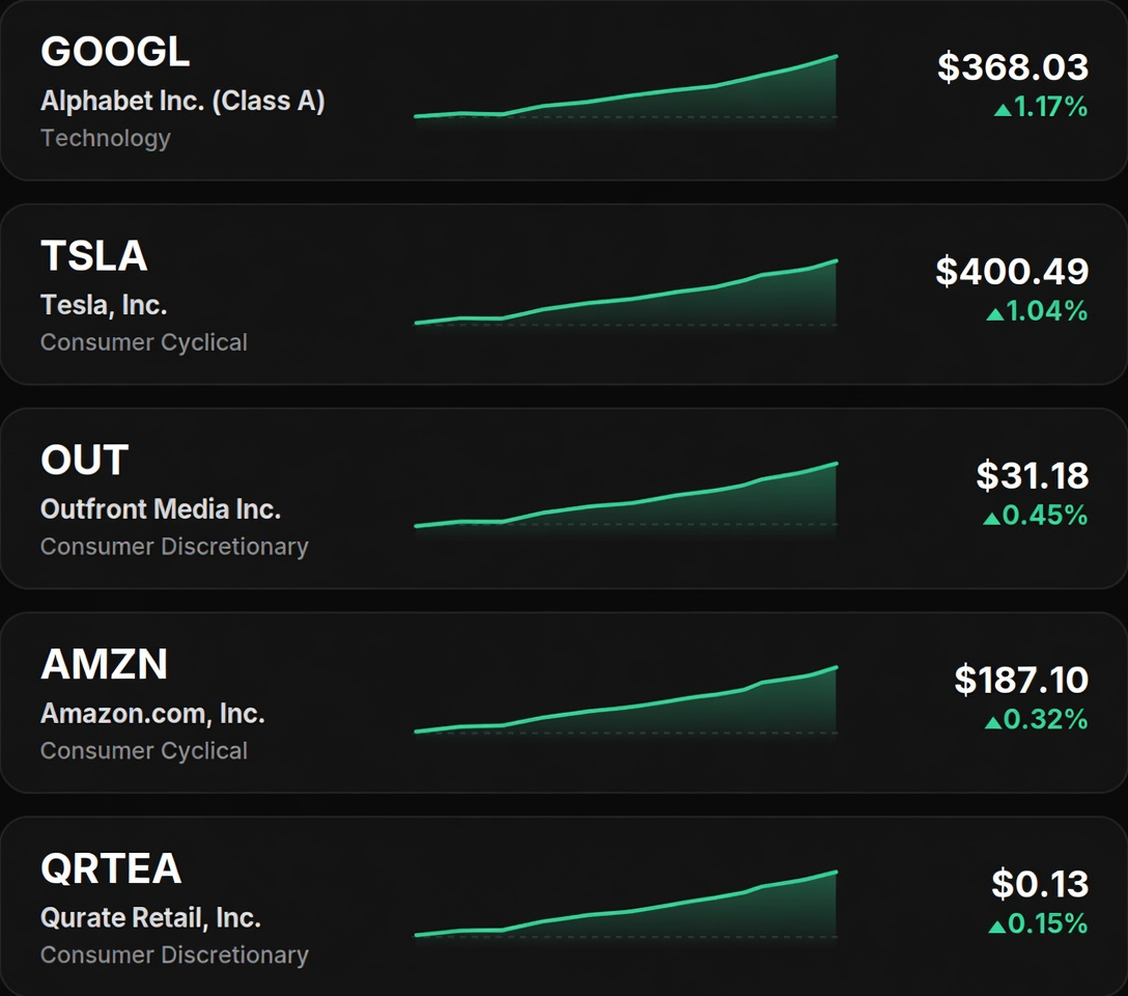
The screens people already live with (GOOGL & TSLA): Alphabet and Tesla outperformed as investors continued to favour businesses built around products people use every day. Alphabet is expanding the role of Google Assistant, Android and connected home devices in everyday life, while Tesla continues to turn the car dashboard into a platform for navigation, entertainment and software services that drivers interact with throughout their journeys. Attention in the physical world (OUT): Outfront Media edged higher as investors continued to value advertising tied to high-traffic locations. Transit displays reach commuters as they move through stations, airports and city centres, offering advertisers visibility that is less affected by ad blockers or changing social media algorithms. Buying without leaving the experience (AMZN & QRTEA): Amazon and Qurate were broadly steady as interactive commerce continued to attract attention. Livestream shopping and video-led retail shorten the journey between discovering a product and buying it, reducing the number of steps where a customer might lose interest or abandon a purchase.
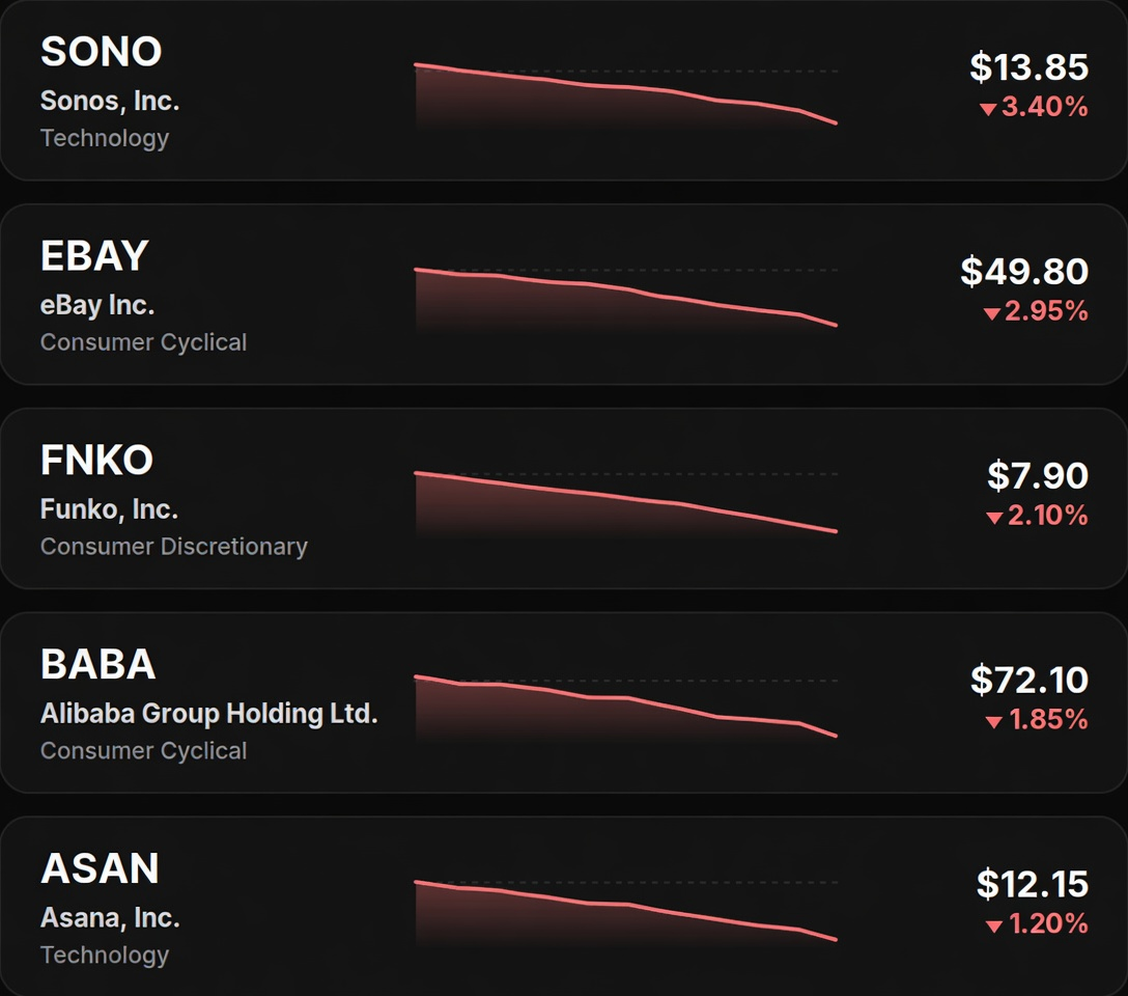
The Hardware Ceiling (SONO): Sonos dipped as standalone ambient audio continues to fight a brutal turf war against full-ecosystem smart screens. When audio portals lack an integrated visual component, they struggle to capture the primary, high-value focus that advertisers and platforms crave. The Hype Decompression (EBAY & FNKO): Both platforms took a hit as engagement with gamified digital collectibles and streetwear drop scarcity cools off. Once consumer attention leaves artificial scarcity models, the underlying economic velocity of these transactional marketplaces drops instantly. The Friction of Execution (BABA & ASAN): Alibaba's international live-retail push ran into heavy customer acquisition headwinds, proving that keeping users anchored to a video shopping feed requires constant, expensive marketing spend. Meanwhile, Asana slipped as workplace focus modification software faces a low ceiling when competing directly for mindshare against addictive consumer feeds.

So turn it on yourself. Forget, for a second, the new channel you keep meaning to launch and the audience you wish you had. Look instead at the attention your customers already hand you, free, every single day. The second they open your email. The screen they stare at while your product loads. The forty seconds they spend on hold.